
When it comes to high-volume manufacturing, picking the right hole-making tool is the difference between an optimized, profitable production floor and a bottlenecked workshop. While legacy tools have their place, modern CNC machining demands tooling that can keep pace with high-feed rates and aggressive cycle times.
At Competence Techno Engineers Pvt Ltd, we closely evaluate tool dynamics to help our partners achieve maximum efficiency. Let’s break down the head-to-head comparison between advanced U Drills (Indexable Insert Drills) and traditional Twist Drills across the three metrics that matter most: speed, chip evacuation, and surface finish.
Technical Comparison: At an At-A-Glance
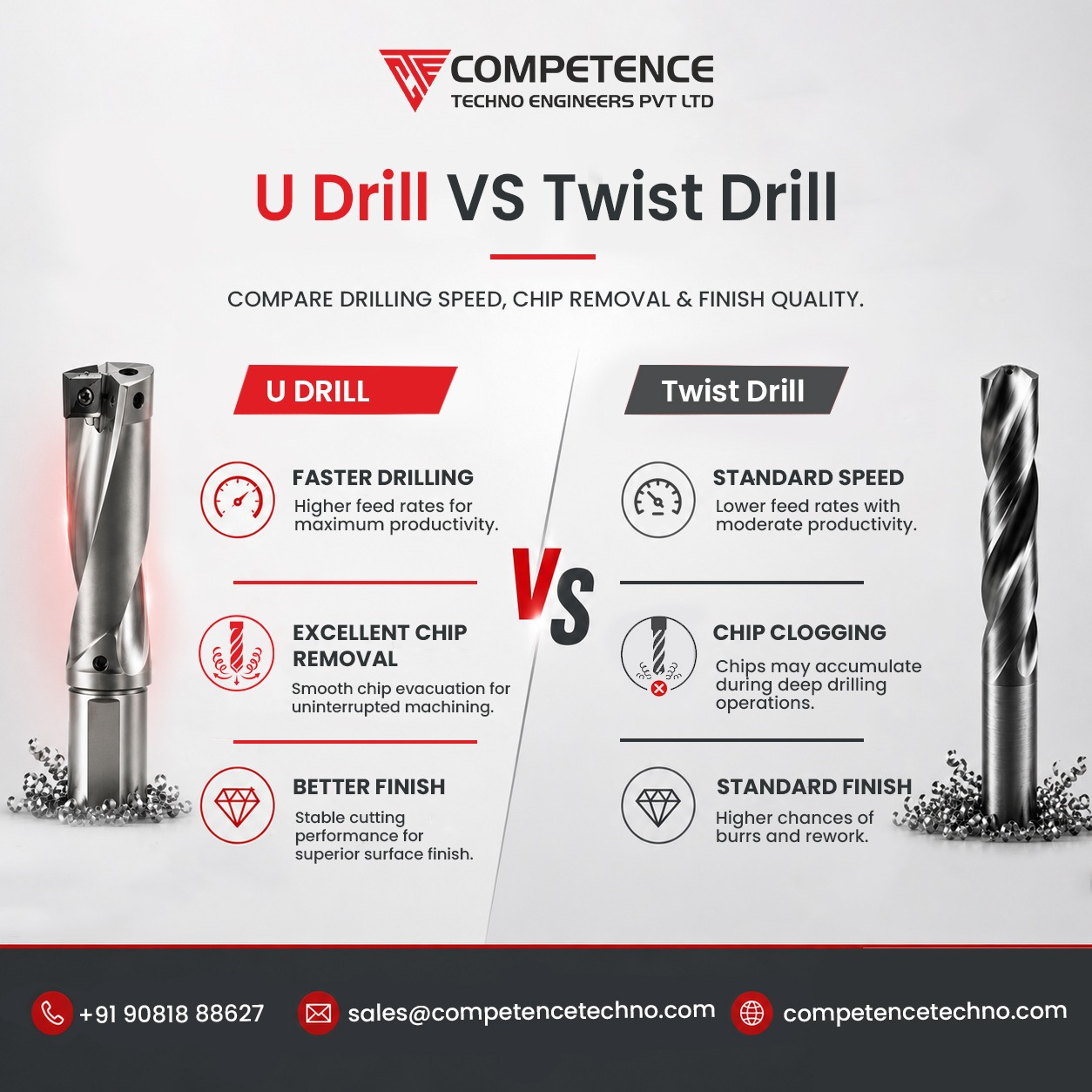
Feature / Metric U Drill (Indexable Insert Drill) Traditional Twist Drill
Drilling Speed & Feed High-Speed: Higher feed rates for maximum productivity. Standard Speed: Lower feed rates resulting in moderate productivity.
Chip Management Excellent Evacuation: Smooth, continuous chip removal for uninterrupted runs. Chip Clogging Risk: Material tends to accumulate and pack during deep drilling.
Surface Finish Quality Superior Finish: Highly stable cutting performance with zero deflection. Standard Finish: Higher risk of exit burrs, requiring secondary rework.
Maintenance Cost Economical: Change indexable inserts quickly without regrinding the body. High Maintenance: Requires frequent manual re-sharpening and regrinding.
Deep Dive: Why Tool Selection Dictates Your Cycle Times
🚀 1. Drilling Speed & Feed Rates
U Drills: Because U Drills utilize asymmetrical carbide inserts (one central and one peripheral), they can cut through material at significantly higher surface feet per minute (SFM). They thrive under high-pressure coolant setups, allowing operators to run aggressive feed rates that smash cycle times.
Twist Drills: Traditional twist drills are limited by their center point geometry, where cutting speed drops to near zero at the very tip. This forces lower feed rates to prevent tool breakage, slowing down your overall output.
🌪️ 2. Chip Removal & Evacuation
U Drills: Built with short, highly rigid bodies and integrated through-spindle coolant holes, U Drills force chips out of the cavity instantly. This prevents recutting of chips and enables smooth, uninterrupted machining.
Twist Drills: The long flutes of a standard twist drill are notorious for chip packing, especially in sticky materials like structural steel or stainless steel. Without constant “peck drilling“ cycles to clear the flutes, chips clog up, threatening tool catastrophic failure.
💎 3. Surface Finish & Hole Integrity
U Drills: High body rigidity eliminates tool deflection or walking. This stable cutting performance ensures perfectly round holes, excellent size consistency, and a clean finish that bypasses the need for a secondary reaming or deburring pass.
Twist Drills: Long flutes are susceptible to flexing under heavy loads. This vibration often leads to out-of-round holes, bell-mouthed entry points, exit burrs, and a higher overall rate of component rework.
The Production Verdict
While standard twist drills remain useful for shallow, manual, or low-volume jobs, CNC automation demands the power of U Drilling. Upgrading your tooling setup directly reduces manual errors, eliminates machine downtime, and unlocks the true potential of your CNC machinery.
Optimize Your Machine Shop with Competence Techno Engineers
Ready to eliminate production bottlenecks and match the right tooling to your CNC machinery? Let our application engineers audit your manufacturing workflows to step up your performance.
Get In Touch Today:
📞 Call Us: +91 90818 88627
📧 Email Us: sales@competencetechno.com
🌐 Visit Our Website: www.competencetechno.com